Freight Rail
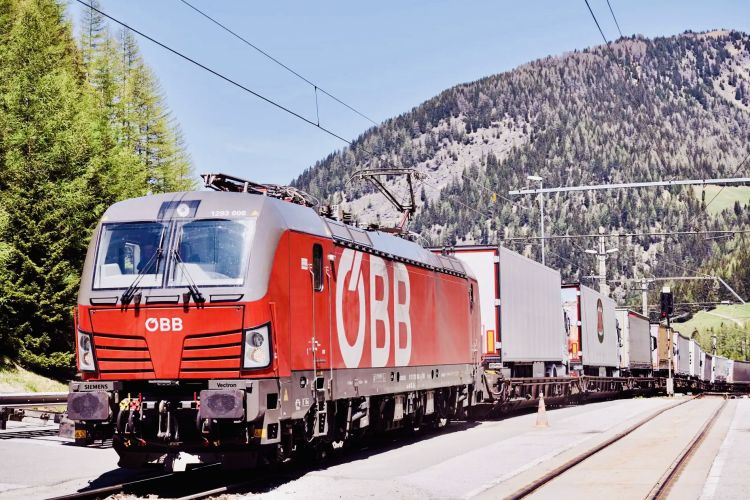
In rail freight transport, market data show a decrease in both net and gross tonne-kilometres transported (by 5.2% and 5.0% respectively). The net tonnes transported also decreased by 6.7%. This was mainly due to the difficult economic situation, the decline in industrial production, high energy prices and route closures due to road works. The ÖBB Group (Rail Cargo Austria) held the largest market share of net tonne-kilometres by company group in 2023 with 57.6%, a decrease of 3.2 percentage points compared to the previous year. The second largest group was made up of privately owned railways (e.g. Lokomotion, Ecco-Rail, CargoServ) with a market share of 25.8%.
"Freight transport suffered from the tense international economic situation, which is why we also want to step up our efforts in this area," explains Leonore Gewessler, Federal Minister for Climate Protection, Environment, Energy, Mobility, Innovation and Technology.
Companies
The number of railway undertakings in Austria was 88 at the end of 2023, with the addition of the freight operators BUDAMAR West (DE), Retrack (DE), Smart Rail Traction (DE), Train - log (DE) and Graf Railservice (AT) compared to 2022. In addition, Schiene Oberösterreich (AT) is a new infrastructure manager. In the year under review, a total of 66 companies were authorised to operate trains on the ÖBB network. Four of them belong to the ÖBB Group, ten others are mainly in the hands of foreign incumbents (market-dominating companies) due to direct or indirect shareholdings. 41 companies are privately owned (with 50% or more shares), the remaining eleven are majority owned by public institutions.
Passenger Rail
The increase in passenger numbers led to a new all-time high in passenger kilometres. Compared to the previous year, the number of passengers increased by more than 12 per cent. On average, each passenger travelled 44.3 kilometres, also a record. Among the factors contributing to this increase were high fuel prices, the expansion of parking space management in urban areas and the introduction of the ClimateTicket.
This development was significantly influenced by the expansion of long-distance services, including the extension of the Westbahn between Vienna and Tyrol (including the extension to Bregenz from December 2023). ÖBB-Personenverkehr also increased its long-distance connections between Austria's conurbations. In local transport, improvements were made in almost all federal provinces, mainly through closer train intervals, longer running times and additional connections at weekends. All in all, these measures led to a record number of over 132 million passenger train-kilometres throughout Austria.
Evaluation
In a survey carried out by Schienen-Control, market participants gave an overall positive assessment of the rail transport market in Austria. Training facilities, the allocation of train paths and the language skills of railway staff were rated particularly highly. However, there is still some catching up to do in terms of competition from other modes of transport, inconsistent EU rules on safety certification and official requirements in the area of personnel. Overall, the internal market performed better than the external market. In particular, operational standards improved, while the availability and cost of services were rated lower than in the previous year.